
Smart Video Surveillance Solution designed for your Industry
Today's security needs go beyond installing cameras and recording footage. Businesses need intelligent monitoring, centralised video management, reliable evidence storage, and the ability to respond quickly to suspicious activity.
We provide smart video surveillance solutions that help organizations monitor their premises, manage security operations, and improve visibility across multiple locations. By combining IP CCTV cameras, intelligent video analytics, centralized surveillance software, and network storage, businesses can move beyond basic monitoring towards a more proactive approach to security.
Whether you manage an office, warehouse, hospital, shopping mall, industrial facility, or public institution, a well-designed CCTV surveillance solution can help protect people, property, equipment, and critical operations.
Why Your Premises Needs a Smart Video Surveillance Solution
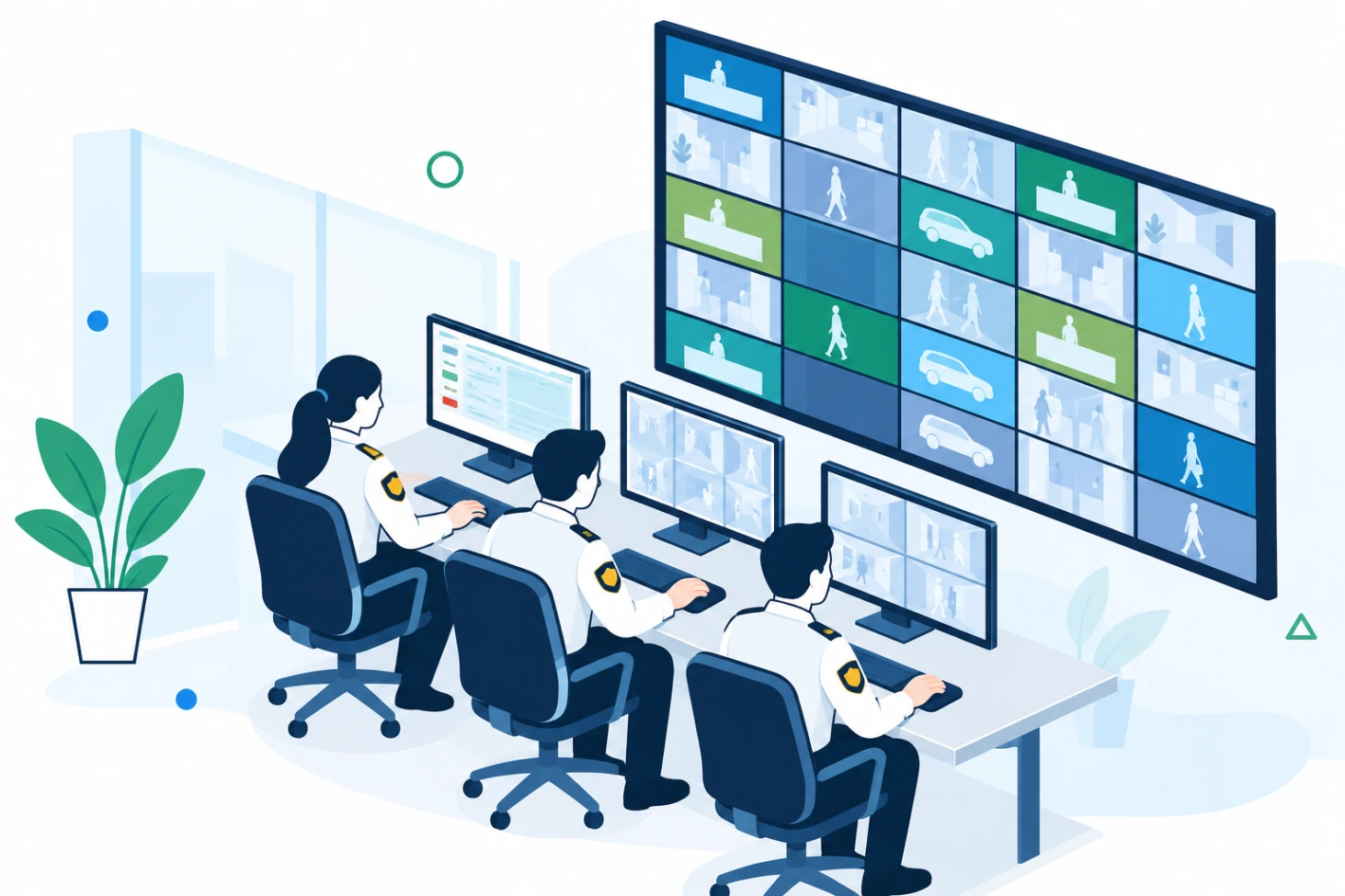
Traditional CCTV systems mainly record footage for review after an incident has occurred. A smart video surveillance solution goes further by combining centralized monitoring, AI-powered video analytics, and instant alerts as incidents occur. It helps security teams monitor activity beyond what the human eye can continuously track, identify potential threats, and respond faster to suspicious events. With intelligent detection, advanced video playback, and real-time notifications, your security team can move from simply recording incidents to proactively monitoring your premises and improving overall security.
Ready to protect your space? Get it
AI-Powered Monitoring Beyond Human Limitations
Monitoring numerous camera feeds continuously can be challenging for even experienced security personnel. Fatigue, distractions, and the sheer volume of video make it difficult to notice every relevant event. AI-powered video analytics helps address this challenge by automatically analysing supported video streams and identifying selected events across multiple cameras.
The technology does not replace human supervision, but it can help security teams focus their attention on events that require investigation.
Centralized Monitoring Across Multiple Locations
Organizations operating multiple buildings, departments, or branches need a coordinated approach to surveillance.Centralized video management software allows authorized users to access camera feeds, review footage, manage alerts, and supervise surveillance operations through a common platform. For larger installations, a dedicated video wall can display selected camera feeds in a central control room, giving security teams a broader view of activities across the premises.
Instant Alerts and Faster Incident Response
A smart surveillance system can generate alerts when configured rules or supported analytics detect a potential incident. For example, if a person enters a restricted area, the system can generate an alert and initiate configured actions such as video recording, image capture, or an on-screen notification. This allows security personnel to investigate events as they occur instead of waiting until someone reviews recorded footage.
Actual alert delivery and response times depend on the software, network, camera capabilities, and notification configuration. The alerts can be shown as pop-ups on the real-time monitoring part of the surveillance software or even configured to reach the admin or security personnel through SMS/Whatsapp/Email.
Improved Security and Threat Detection
Strategically positioned video surveillance security cameras help monitor entrances, exits, corridors, parking areas, loading bays, restricted zones, and facility perimeters. With compatible AI-powered analytics, the system can detect events such as area intrusion, line crossing, human and vehicle activity, and other configured behaviours. This helps security teams identify potentially suspicious activities that might otherwise go unnoticed.
Solution Design: How Our Smart Video Surveillance System Works
The system follows this general architecture:
IP CCTV Cameras → Gigabit Network Switches → Video Surveillance Servers → Surveillance Software
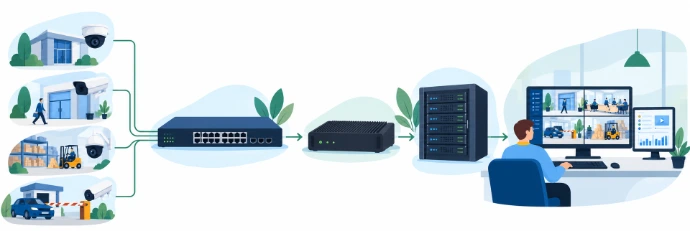
IP cameras capture video from designated areas.
Gigabit switches transport camera streams across the network.
Surveillance servers host the video management software and coordinate supported monitoring functions.
Where configured, the SmartBox processes compatible video streams for supported AI analytics.
Configured analytics and alarm rules generate alerts when supported events are detected.
Security personnel view authorized camera feeds from their assigned desktops and investigate relevant events.
The video wall displays selected feeds for centralized supervision.
Network storage retains footage according to the configured recording and retention policies.
Features of Our Smart Video Surveillance Solutions
Depending on the selected software, cameras, hardware, licensing, and system configuration, the following features can be incorporated.
AI-Powered Video Analytics
A major component of an intelligent surveillance system is the ability to analyse video and identify relevant events automatically. A smart box is integrated to conduct video analytics from compatible camera streams, helping security teams identify events that require attention.
Depending on the selected model, compatible cameras, and enabled analytics, capabilities may include:
Perimeter protection: Detection of supported intrusion, tripwire crossing, climbing, and wandering events.
Human and vehicle analysis: Processing of supported human and vehicle detection data.
People counting: Monitoring and counting people in supported scenarios.
Licence-plate-related analytics: Processing of supported vehicle and licence-plate information.
Scenario-specific detection: Selected analytics for environments such as construction sites, industrial facilities, petrol stations, and smart communities.
When integrated with compatible surveillance software, supported analytics can help generate alerts for configured events, enabling personnel to investigate potential incidents promptly.
AI analytics do not guarantee detection of every incident. Accuracy depends on camera placement, lighting, environmental conditions, and configuration.
High-Capacity Video Management
The surveillance platform supports up to 1,024 video channels, with up to 64 channels available for simultaneous live preview and 16 channels for simultaneous real-time playback. This capability supports large deployments requiring centralized monitoring across multiple buildings or locations. Actual performance depends on server resources, network capacity, camera stream settings, and software licensing.
Video Patrol and Patrol Records
Video patrol features help security personnel follow defined monitoring routines, review designated camera views, and improve situational awareness. The software can maintain patrol records, supporting supervision, operational accountability, and performance reviews.
Essential Video Management
The surveillance platform supports essential monitoring and playback functions, including:
Real-time video preview.
PTZ (Pan-Tilt-Zoom) camera control.
Recorded video playback.
Video decoding.
Video wall management.
Electronic maps (E-maps).
These capabilities allow security teams to view live activity, navigate camera locations, control supported cameras, and review recorded events from a centralized interface.
Watermark Protection
The watermark function helps protect photos and data against unauthorized copying and reuse, providing an additional safeguard for surveillance-related materials.
ONVIF-Compatible IP CCTV Cameras
Our surveillance designs can incorporate compatible ONVIF IP CCTV cameras, subject to the supported ONVIF profiles, software version, and device capabilities.
Get the solution Get it
Who Is This Solution For?

A smart video surveillance solution is ideal for organizations that need reliable security monitoring, incident records, and greater visibility across their premises. Corporate and commercial offices can monitor entrances, reception areas, server rooms, and parking facilities, while industrial and logistics facilities can oversee warehouses, production areas, loading bays, and vehicle movements. Healthcare facilities can protect designated areas while respecting patient privacy, and government institutions and public spaces can benefit from centralized monitoring, intelligent alerts, and recorded evidence to support security operations.
The solution is also valuable for construction sites, where cameras help monitor equipment, materials, and site perimeters; retail stores and shopping malls, where surveillance supports monitoring of sales floors, stockrooms, and parking areas; and schools, universities, hotels, apartments, and residential properties, where it helps improve safety and protect shared spaces. It can also serve banks, transport facilities, utilities, and other commercial environments. Each system is tailored to the premises' security risks, privacy requirements, network infrastructure, and operational needs.
Advantages Over Typical Video Surveillance Solutions
A conventional NVR (Network Video Recorder) and camera installation can provide effective recording and playback for many premises. However, organizations with larger or more complex security requirements may benefit from a centralized video management platform with intelligent analytics, surveillance personnel management, and advanced monitoring capabilities.
The main difference is not simply whether a system uses IP cameras or an NVR. It is how the entire surveillance environment is managed, monitored, and scaled.
AI-Powered Analytics Instead of Basic Motion Detection Alone
Basic CCTV systems may rely primarily on manual observation and conventional motion detection. A smart surveillance platform can incorporate advanced analytics such as human and vehicle analysis, line crossing, area intrusion, target counting, and edge-based analytics for compatible camera streams, helping identify configured events across multiple channels. This helps security personnel focus on relevant events rather than relying entirely on continuous manual observation.
Integration with Other Security Systems
Where supported by the selected platform, surveillance can form part of a broader security environment incorporating access control, attendance, visitor management, and other building systems. For example, an organization may want to review camera footage associated with an access event or manage personnel and access permissions alongside surveillance.
Surveillance Personnel Management
Large facilities may have several guards, supervisors, and control-room operators who need access to the same surveillance system. Personalised user accounts and permissions allow administrators to manage which cameras, functions, and resources each operator can access.
This supports more structured surveillance operations than relying on a single shared account.
Instant Alerts as Incidents Occur
In a conventional recording-focused system, an incident may only be discovered when someone reviews the footage. With configured intelligent analytics and alarm management, a smart video surveillance solution can generate alerts when supported events occur. Security personnel can then review the relevant camera feed and initiate the appropriate response.
This supports more proactive monitoring, although the actual response depends on the alert configuration, network availability, and the actions taken by security personnel.
Request a site visit today Book Now
What We Consider Before Deploying a Smart Video Surveillance Solution
At NobleFrame Technologies, we begin every smart video surveillance project by assessing the client's premises, security objectives, and operational requirements. This helps us design a CCTV surveillance solution that provides the required camera coverage, supports intelligent monitoring, and can be expanded as the client's needs evolve. Before deployment, we focus on four key considerations.
Site Assessment and Camera Coverage
We conduct a site assessment to identify security risks and determine the strategic placement of IP CCTV cameras. This involves evaluating entrances, exits, perimeters, parking areas, loading bays, storage rooms, and other sensitive locations. We consider camera resolution, viewing angles, lighting conditions, potential blind spots, and environmental exposure to ensure that each camera is suitable for its intended purpose. We also account for privacy requirements when determining camera locations.
Example: For a warehouse client, we may recommend high-resolution cameras at entry and exit points to capture identifiable details, while wider-angle cameras cover storage areas and loading bays. Where appropriate, compatible cameras and analytics can be incorporated to help detect unauthorized entry into restricted areas.
Network Infrastructure and System Capacity
We assess the client's existing network infrastructure to determine whether it can support the proposed surveillance system. Our assessment considers the number of cameras, video resolution, bandwidth requirements, network switches, cabling, Power over Ethernet (PoE), and connectivity between cameras, surveillance servers, operator workstations, and network storage. Where necessary, we design a dedicated or segmented surveillance network with suitable gigabit switches and uplinks to support reliable video transmission and future expansion.
Example: For a commercial building requiring 80 IP CCTV cameras, we assess the expected network traffic and design the switching infrastructure accordingly. This may include gigabit switches, appropriate uplinks, and a dedicated surveillance network connecting the cameras to the video management servers and authorized monitoring stations.
Video Management Software and AI Analytics
We identify the client's monitoring and reporting requirements before selecting the appropriate video management software and analytics equipment. This includes determining the required camera capacity, number of operators, alarm management functions, video wall requirements, and any integration with access control or other security systems.We verify compatibility, licensing, and the availability of the required features before finalizing the design.
Example: For a manufacturing facility that needs to monitor restricted production areas, we may propose compatible IP cameras, suitable video management software, and a ZKIVA-EDGE X1 SmartBox where appropriate. We configure supported intrusion analytics to generate alerts when defined events occur, allowing authorized security personnel to review the relevant footage and respond according to the client's security procedures.
Video Storage, Retention, and System Reliability
We calculate the storage capacity required to retain recorded footage for the period specified by the client. Our design considers the number of cameras, resolution, frame rate, compression, recording schedules, and retention requirements. We also assess server performance, network storage, power protection, redundancy, cybersecurity, and backup requirements to help ensure that footage remains accessible when needed. Where cloud-based video surveillance is being considered, we evaluate the platform's capabilities, internet connectivity, data protection requirements, and associated costs before recommending an appropriate on-premises, cloud, or hybrid arrangement.
Example: For a financial institution that requires 60 days of video retention, we calculate the estimated storage capacity based on the proposed camera configuration and recording policy. We may recommend dedicated surveillance servers and network storage, together with appropriate power protection and a separate backup arrangement where required, to support the client's retention and reliability objectives.
Check out our surveillance solutions⬇️
Final Thoughts
A modern CCTV surveillance solution should do more than record footage. It should help organizations monitor their premises, identify relevant events, investigate incidents, manage surveillance personnel, and plan for future security requirements.
By combining IP CCTV cameras, AI-powered video analytics, instant incident alerts, centralized video management, a dedicated surveillance room, operator workstations, and network storage, businesses can establish a more coordinated and proactive approach to security.
Whether you need surveillance for a single commercial building or a large multi-camera environment, the right design begins with understanding your risks, infrastructure, and operational objectives.